
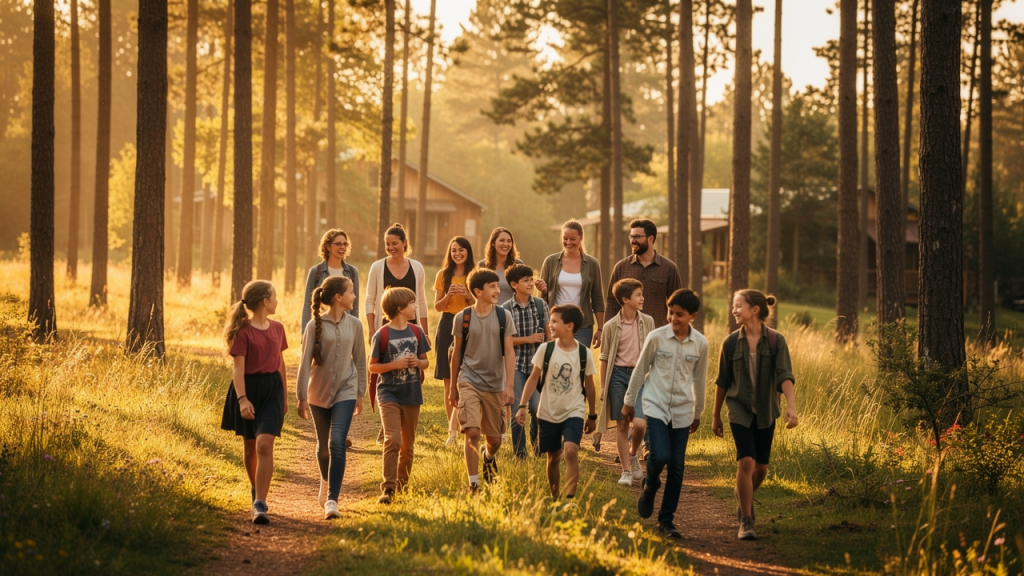
Otzma Camps and Seminars for IDF Orphans at Every Age form an organized initiative that provides structured bereavement support, social integration, and developmental empowerment for children, adolescents, and young adults who lost a parent while serving in Israel's security forces. The framework behind Otzma camps and seminars for IDF orphans spans early childhood through the university years, adapting format and content to each developmental stage. This article outlines program structures, age-specific adaptations, psychosocial safeguards, eligibility pathways, and the community support that continues once a seminar or camp session ends.
One Common Misunderstanding: Camps and Seminars Are Not Interchangeable
Families new to the framework often assume a camp and a seminar serve the same purpose. A residential camp is an immersive, multi-day experience built around therapeutic recreation, active socialization, nature expeditions, and stress relief inside a secure group setting. A seminar is a shorter, discussion-based gathering focused on identity development, transitional life skills, and mutual sharing among peers. Both rely on grief-informed programming and trauma-informed care, but the delivery differs: camps lean on structured group workshops layered around activity, while seminars center on conversation and reflection.
Peer Normalization and Resilience Building
Isolation is a recurring difficulty for orphans of fallen soldiers, particularly when classmates cannot relate to their experience. Otzma settings rely on peer normalization: when everyone in the room carries a similar loss, the burden of explanation disappears, and participants process complex emotions without having to justify them first. This dynamic supports bereavement support goals and reinforces resilience building inside a peer support group where shared history replaces isolation. Broader research on psychological resilience describes how social connection after loss shapes long-term coping capacity, a pattern the program applies directly through repeated peer contact.
Age-Specific Programming from Childhood to Young Adulthood
Program design shifts considerably between a six-year-old and a twenty-two-year-old, both in structure and in the topics addressed. The table below summarizes the general approach across three cohorts.
| Age Group | Format and Setting | Primary Focus |
|---|---|---|
| Elementary and Middle School (6-12) | High supervision, predictable daily routine, sensory-soothing activities | Structured play, expressive arts, age-appropriate curriculum, child protection protocols |
| Adolescents and Teens (13-18) | Adventure-based challenges, team exercises, evening discussion circles | Identity formation, legacy, emotional ambivalence, resilience building |
| Young Adults (18 and above) | Seminar format, lectures and workshops, cohort-based discussion | Higher education, career entry, independence, bereavement support |
Adolescent Programs and Documented Models
Teen programming carries the heaviest emotional load because adolescents are old enough to articulate loss but still forming a stable sense of identity. Sessions combine adventure-based challenges with team-building exercises and open discussion about legacy, a pattern reflected in documented camp gatherings covered by national media, where bereaved teenagers took part in extreme sports alongside structured conversation. These programs speak directly to IDF bereaved families whose adolescents need both physical release and a forum for identity questions that resilience building alone cannot address.
Staffing Ratios and Safety Metrics Behind Otzma Programs
The professional layer behind each session is deliberately narrow in scope. Programs offer supportive, grief-informed mentoring rather than formal acute clinical psychotherapy; licensed social workers, educational psychologists, and bereavement professionals maintain on-site presence, but a participant in psychiatric crisis is referred outward rather than treated on location. Clinical supervision governs staff conduct throughout, and psychosocial support runs alongside recreational activity rather than replacing it. Operationally, a strict counselor-to-participant ratio is maintained across every cohort, medical clearance is required before arrival, medication management is handled exclusively by designated health officers, and a baseline safeguarding policy applies uniformly, reinforcing the same child protection protocols used in the youngest age groups.
Camp or Seminar: Matching Readiness to the Right Track
Before assignment, families move through a verification step confirming recognized status through national defense and rehabilitation authorities, followed by a multi-stage pipeline: application submission, medical form review, and a personal conversation. The intake assessment and an individual screening interview evaluate emotional readiness and match each candidate to the cohort suited to their needs, a step that matters most for IDF bereaved families weighing a residential program for the first time.
Readiness Benchmarks for Residential Immersion
Grief-informed programming works best when a participant shows baseline emotional stability, willingness to join communal living, and the ability to self-regulate with staff guidance nearby. Attendance is typically deferred when a candidate faces an active, unmanaged psychiatric crisis or extreme social withdrawal requiring intensive one-on-one therapy; in these cases, a phased, community-based introduction replaces immediate residential placement, protecting both the individual orphan of fallen soldiers and the group around them.
When a Family Applies: Costs, Logistics, and In-Session Support
Core activities, accommodation, full board, and security are heavily subsidized or fully funded through organizational endowments and defense-related allocations, which keeps direct cost low for IDF bereaved families. Standard arrangements include secure charter transportation, dietary accommodations, accessibility modifications, and clearly stated cancellation terms, all part of the bereavement support structure surrounding each session.
Inside the program, staff watch for acute emotional triggers, sensory overload, homesickness, or friction between participants. Quiet breakout spaces, designated emotional support staff, and a defined de-escalation sequence handle these moments, with guardians notified directly if a temporary pause from group activity is recommended. This layer of trauma-informed care and psychosocial support runs continuously rather than only during scheduled discussion blocks.
The attached link will lead you to all the relevant information: idfwo.org.
What Happens After the Program Ends?
Returning from a week of close peer solidarity to an ordinary school or work routine can feel abrupt, sometimes called the re-entry drop-off. Caregivers are encouraged to keep conversations open-ended, accept a period of decompression fatigue without pushing for a summary of the experience, and treat quiet withdrawal as a normal part of the post-program follow-up rather than a setback in resilience building.

Relationships formed during camps and seminars extend into adulthood through regional meetups, digital alumni groups, and mentoring roles. Many older orphans of fallen soldiers return as counselors themselves, turning the peer support group that once held them into the structure they now offer to younger participants, a cycle that keeps bereavement support active well beyond any single session.
What is the difference between an Otzma camp and an Otzma seminar?
A camp is a multi-day residential experience built around activity, nature, and group living, while a seminar is a shorter, discussion-focused gathering aimed at identity development and life-skills conversation, typically for older participants.
What age groups can join these programs?
Programming runs from elementary school through young adulthood, with format and content adjusted for each stage, from structured play for younger children to career and independence topics for young adults.
Is clinical therapy provided on site?
No. The programs offer grief-informed mentoring supported by social workers and psychologists, but acute psychiatric treatment is handled through outside referral rather than on-site clinical therapy.
What does participation typically cost a family?
Core costs are heavily subsidized or fully covered through organizational funding and defense-related allocations, so direct expense for eligible families is minimal.
About the Business
The IDF Widows and Orphans Organization is a non-profit association recognized by the Ministry of Defense as the body dedicated to caring for the widows, widowers, and orphaned children of Israel's fallen soldiers and security personnel. The organization stands beside bereaved families through every stage of life, offering educational scholarships, holiday stipends, therapeutic camps, milestone celebrations, and ongoing emotional advocacy designed to meet the specific needs of those left behind after military loss.